In a discussion fitting for a Martin Luther King Jr. commemoration, religious leaders from multiple faith traditions explored how belief systems can either uplift workers’ dignity—or undermine it—in today’s polarized political climate.
The panel, held during the AFL-CIO’s annual MLK conference in Baltimore, brought together a Jewish rabbi, a Catholic priest, an imam, and a Princeton University professor to examine the evolving relationship between faith and work since King, a Baptist minister, helped lead the civil rights movement and co-founded the Southern Christian Leadership Conference in 1957.
That relationship, speakers said, is now more prominent—and more contested—than ever.
Faith as a force for worker justice
On the positive side, African Americans—who made up a majority of the conference’s 1,179 delegates and guests—remain among the most religiously observant groups in the U.S. They are also consistently pro-worker, pro-union, and supportive of progressive public policy.
That tradition continues through leaders such as the Rev. William Barber II and the Rev. Liz Theoharis, co-chairs of the Poor People’s Campaign, who regularly draw on Christian and Jewish teachings to advocate for economic justice and the eradication of poverty.
Progressive faith traditions have long aligned with labor and civil rights causes, including Reform and Reconstructionist Judaism, Quakers, Episcopalians, Methodists, and segments of the Catholic Church. Pope Francis I was a vocal critic of unchecked capitalism and an outspoken defender of workers’ rights. His successor, Pope Leo XIV, has continued that engagement, meeting early in his papacy with Catholic labor leaders from his hometown of Chicago, accompanied by Cardinal Blaise Cupich.
Religion used to divide
But speakers also warned of the darker side of religion’s role in modern politics and labor.
They pointed to the growing influence of fundamentalist movements, particularly the overwhelmingly white Southern Baptist Convention and aligned evangelical megachurches, whose leaders often reject church-state separation, oppose unions, and embrace far-right politics. Polls show more than 81% of extremely religious white voters supported Donald Trump, and they vote in large numbers.
“These groups promote rugged individualism, distrust government and institutions—including unions—and reject the idea of collective responsibility,” panelists noted.
Ultra-Orthodox Jewish sects and other fundamentalist groups were also cited as rejecting democratic norms and pluralism.
Faith, solidarity, and rising hate
Against that backdrop, panelists emphasized how progressive faith communities can help workers reclaim dignity, respect, and power on the job.
“Progressive religious leaders are feeding people hope that we can have dialogue together on the problems we face,” said Imam Earl El-Amin of Baltimore’s Muslim Community Cultural Center.
That hope is under strain, however, amid rising antisemitism and Islamophobia across the political spectrum.
Rabbi Rachel Gartner of Georgetown University cited the recent arson attack on the oldest synagogue in Jackson, Miss., where a white teenager filmed himself setting the building on fire.
“White supremacist ideology has antisemitism at its core,” Gartner said.
“Tyrannies work by convincing us we cannot work together,” she added. “They want us furious at each other, not curious about each other. Faith communities can play a powerful role if we do the hard work of softening one another.”
She also warned that faith communities must actively oppose religious extremism at the ballot box, noting that in Germany’s early 1930s elections, progressive forces failed to unite. “The Nazis won power with only 33.1% of the vote,” she said.
Faith, capitalism, and hypocrisy
Princeton professor Eddie Glaude Jr., an expert on African-American history and religion, warned that faith divorced from social responsibility can enable exploitation.
“When faith is detached from social theory, we get in trouble,” Glaude said. “There are corporate interests out to exploit working people. Our faith tradition should help us see each other as made in the image of God—and confront an economic system that treats people as disposable.”
Breaking through to white evangelical voters will be difficult, he acknowledged.
“Will they accept Donald Trump’s assaults on immigrants and people of color?” Glaude asked. “That will be the test. Their despotism is not an accident.”
He accused many white evangelical leaders of abandoning core Christian teachings. “Jesus said, quoting Isaiah, ‘The spirit of the Lord is upon me to bring good news to the poor.’ We need a modern-day movement that exposes their hypocrisy.”
Looking to the next generation
The Rev. Jim Wallis, founder of Georgetown University’s Center on Faith and Justice, said younger generations may offer hope, even as many move away from organized religion.
Pew surveys show the fastest-growing “religious” group in the U.S. is the “nones”—those who claim no formal faith affiliation.
Still, Wallis said, young people remain deeply motivated by moral purpose.
“They’re open to something larger than themselves,” he said. “What excites them is seeing people of faith put faith into action—standing beside them in the fight for justice.
“When we act,” Wallis added, “we bring faith to life.”
-------------------------------------------
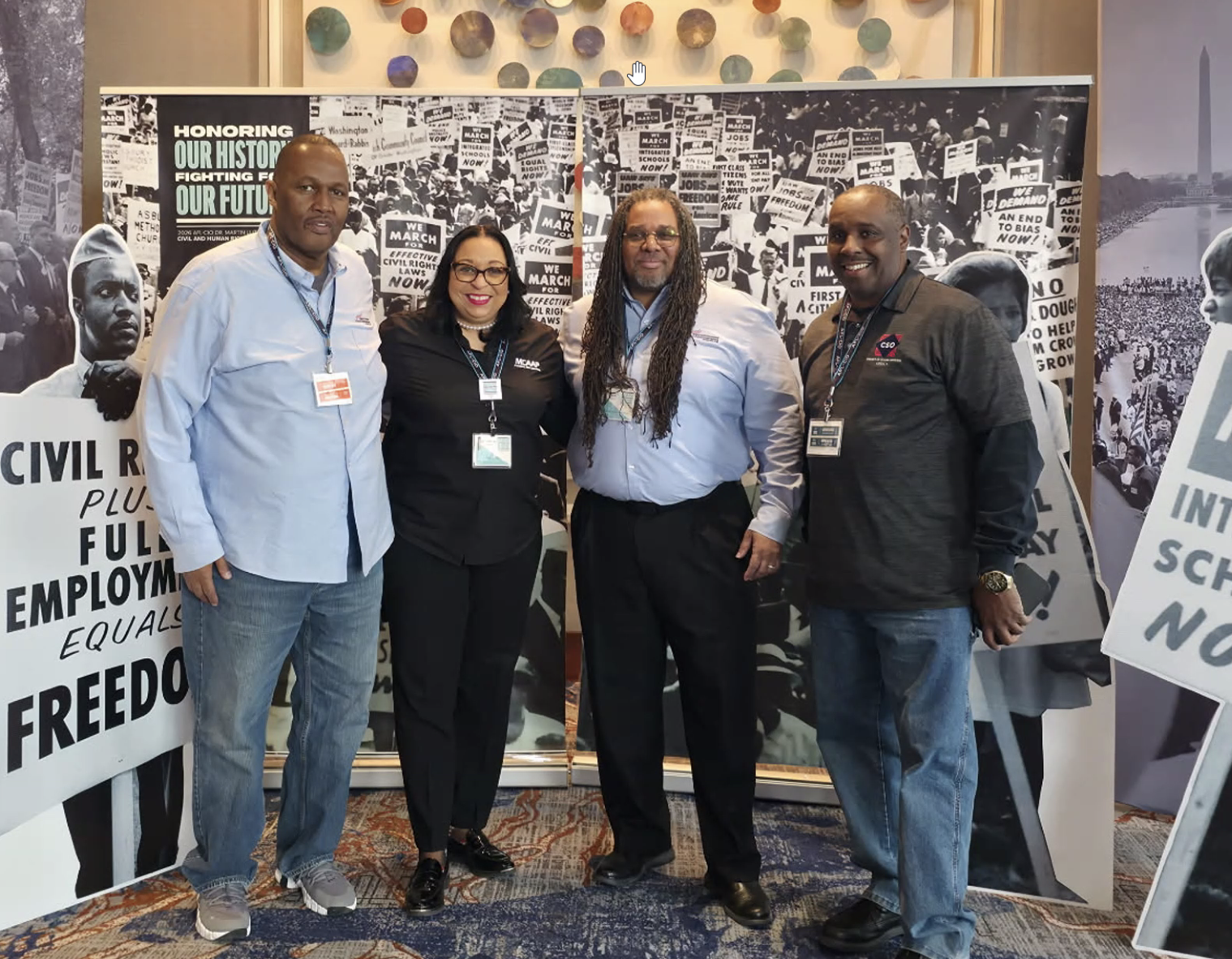
AFSA Leadership attended the AFL-CIO's MLK Conference in Baltimore. In the pictures Karl E. Perry, AFSA Secretary-Treasurer, AFSA General VP's Christine Handy and Richard Jackson and Robert Saunders, VP of Local 4 CSO.