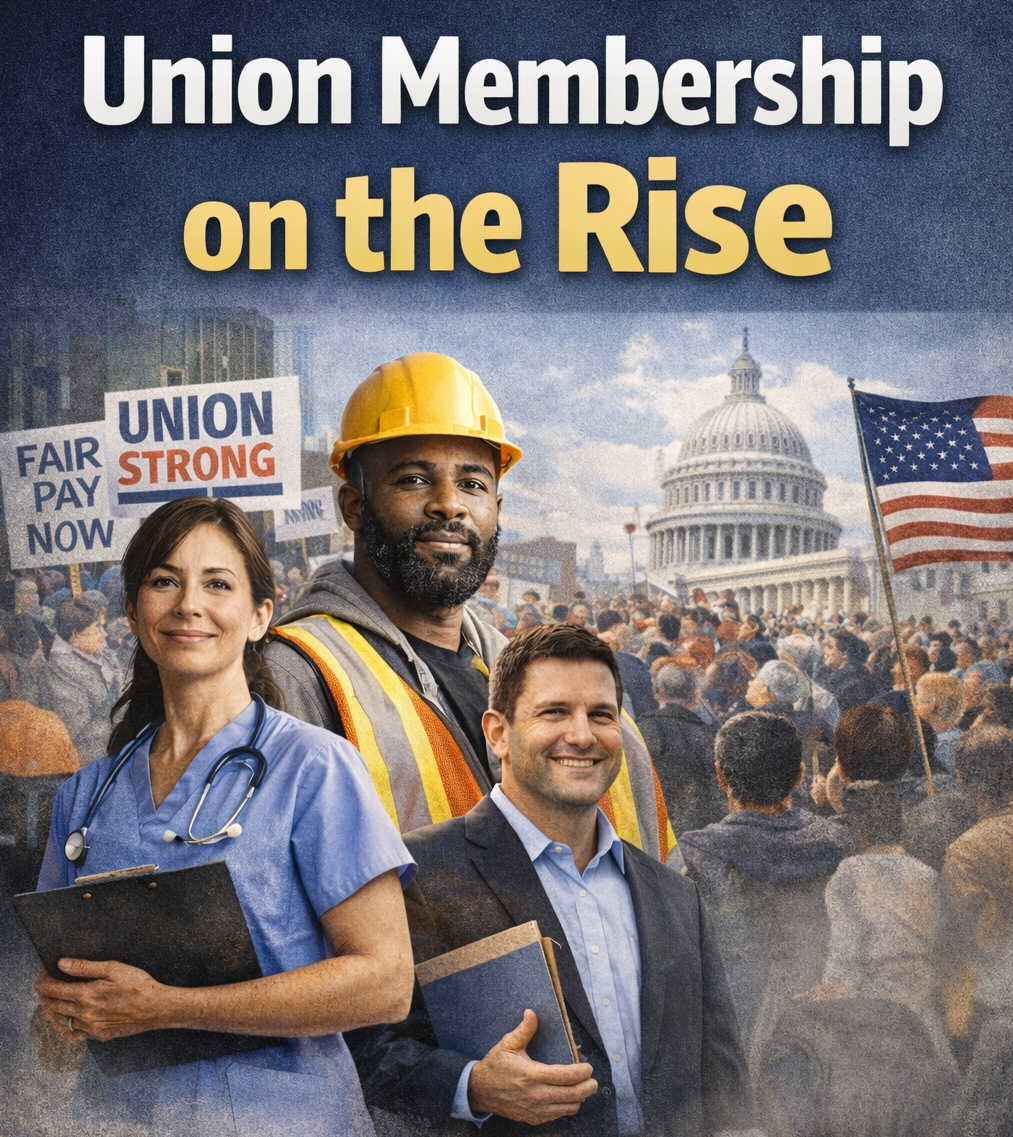
Nearly half a million workers joined union ranks in 2025, marking one of the strongest years for organized labor in more than a decade—despite what labor leaders describe as sustained political and corporate attacks on collective bargaining rights.
New data released by the U.S. Bureau of Labor Statistics shows union representation grew by 463,000 workers last year, bringing the total number of workers covered by union contracts to 16.5 million. Union density rose to 11.2% of all wage and salary workers, the highest level in 16 years and an increase over 2024.
AFSA reported major organizing victories in 2025, including large membership increases in Fairfax County, Virginia, and San Diego County, California. Those wins added hundreds of school leaders and education professionals to union rolls, reflecting continued organizing momentum in public education.
The numbers in the private sector underscore what union leaders say has been a years-long organizing surge across industries and regions, including in states historically resistant to organized labor.
“Billionaire bosses and union-busting politicians have tried to throw the kitchen sink at working people and their unions—slashing our jobs and rigging the rules to scare us out of organizing—but they are failing,” said Liz Shuler, president of the AFL-CIO. “Workers know that the best check on a bad boss is a strong union contract.”
Shuler pointed to growing public support for organized labor, noting that nearly 70% of Americans support unions and tens of millions more say they would join one if given the opportunity. At the same time, she criticized what she described as weakened labor law enforcement and delays in union election certifications when the National Labor Relations Board lacked a quorum.
The 2025 data show broad-based gains:
Union density nationwide reached 10%, driven in part by years of organizing in new industries and in “right to work” states in the South.
Nearly half of all union growth came from Southern states, with younger workers organizing at a rapid pace.
Public sector union membership grew by 236,000 workers, raising density in that sector to 36.4%.
Union density among federal workers climbed to over 31%—the largest single-year increase since 2011.
Private sector union representation grew by 227,000 workers, with significant gains in health care, retail, education services and construction.
According to research from the Economic Policy Institute, union workers continue to earn significantly higher wages and are more likely to receive employer-provided health insurance and retirement benefits than their nonunion counterparts. EPI has also documented how union contracts help reduce racial and gender wage gaps and strengthen workplace safety standards.
At the same time, unions say workers are increasingly organizing in response to rapid technological change. As artificial intelligence reshapes industries, labor leaders argue that collective bargaining agreements are essential to protecting jobs, ensuring retraining opportunities and setting guardrails on the use of new technologies. Recent reports show that 7% of planned job cuts in 2025 were attributed to AI-related restructuring.
“Labor is one of the last institutions in this country that working people actually trust,” Shuler said. “Politicians face a clear mandate to stand up to union-busting bosses—whether they are in the corner office or the Oval Office.”
Shuler renewed calls for Congress to pass the Protecting the Right to Organize (PRO) Act, the Public Service Freedom to Negotiate Act and the Protect America’s Workforce Act, legislation aimed at strengthening labor law protections and restoring collective bargaining rights.
With union membership climbing and public support holding strong, labor leaders say 2025 may mark not just a rebound year—but a continuation of a broader, worker-led movement to reclaim economic and workplace power across the country.